
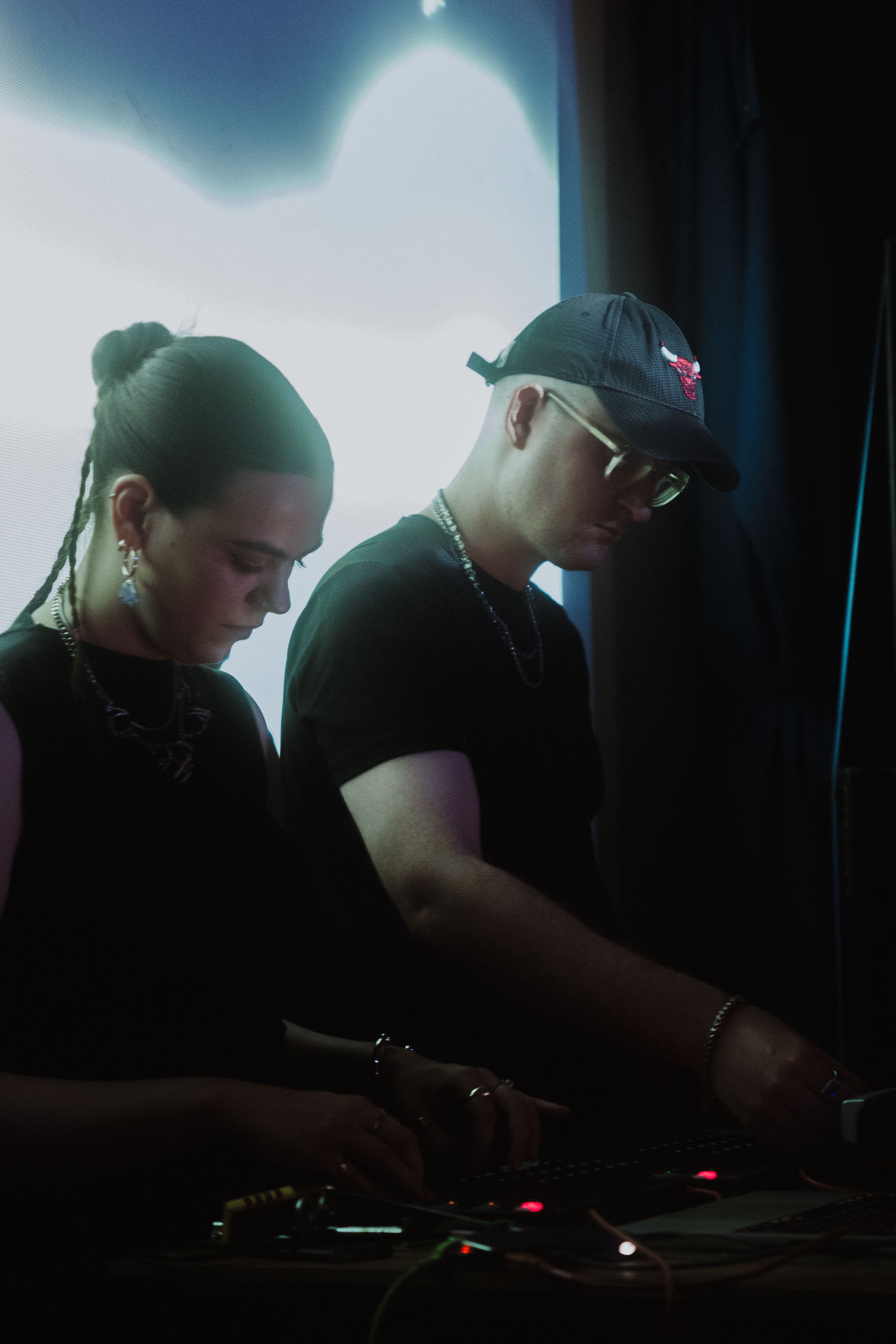
Credit: Edward Sogunro
Sitting in a park, coffee in hand, Callum tells me, ‘I think our music would send a Victorian child into a coma.’ Pausing to consider, he adds, ‘and would probably kill Beethoven.’
Imogen Davey and Callum Murray are the two halves that make up the audiovisual duo snake_case, whose work plays with the boundaries between humans and machines, incorporating code and algorithm. It’s a far cry from the chord progressions of Beethoven, interrogating how technology can be used within music.
Imogen and Callum both come from more conventional musical backgrounds (classical and jazz respectively.) Callum started playing around with algorithmic inspired pieces pre-pandemic, giving himself sets of rules with rhythms and pitches and seeing what the musical outcome was. During the pandemic he had more time and started using programming to create musical scores. This developed into creating more of his own algorithms and synthesizing audio.
Imogen’s process developed differently. She describes it as an ‘audio collage’, gathering her own field recordings or sourcing them from vast databases of human and non-human sounds. The whole world is her receptacle, finding music in the most surprising places.
The two processes laid the foundations for their work, each one now used by both Imogen and Callum. The ideas they want to explore have also intermingled. Imogen is fascinated by memory and nostalgia, a slippery part of the human emotional ecosystem that creeps up on us to floor us. ‘Every time you think about a memory, you go back to it. Are you remembering the memory of that memory or the actual moment? It’s kind of the same if you’re revisiting a sound.’
Callum agrees, but his approach is more focused on taking apart the way music triggers both emotion and memory. ‘I’ve always wanted to ‘work out’ music, which is kind of an impossible task. Why am I associating sounds with certain memories or feelings or sensations in my body?’
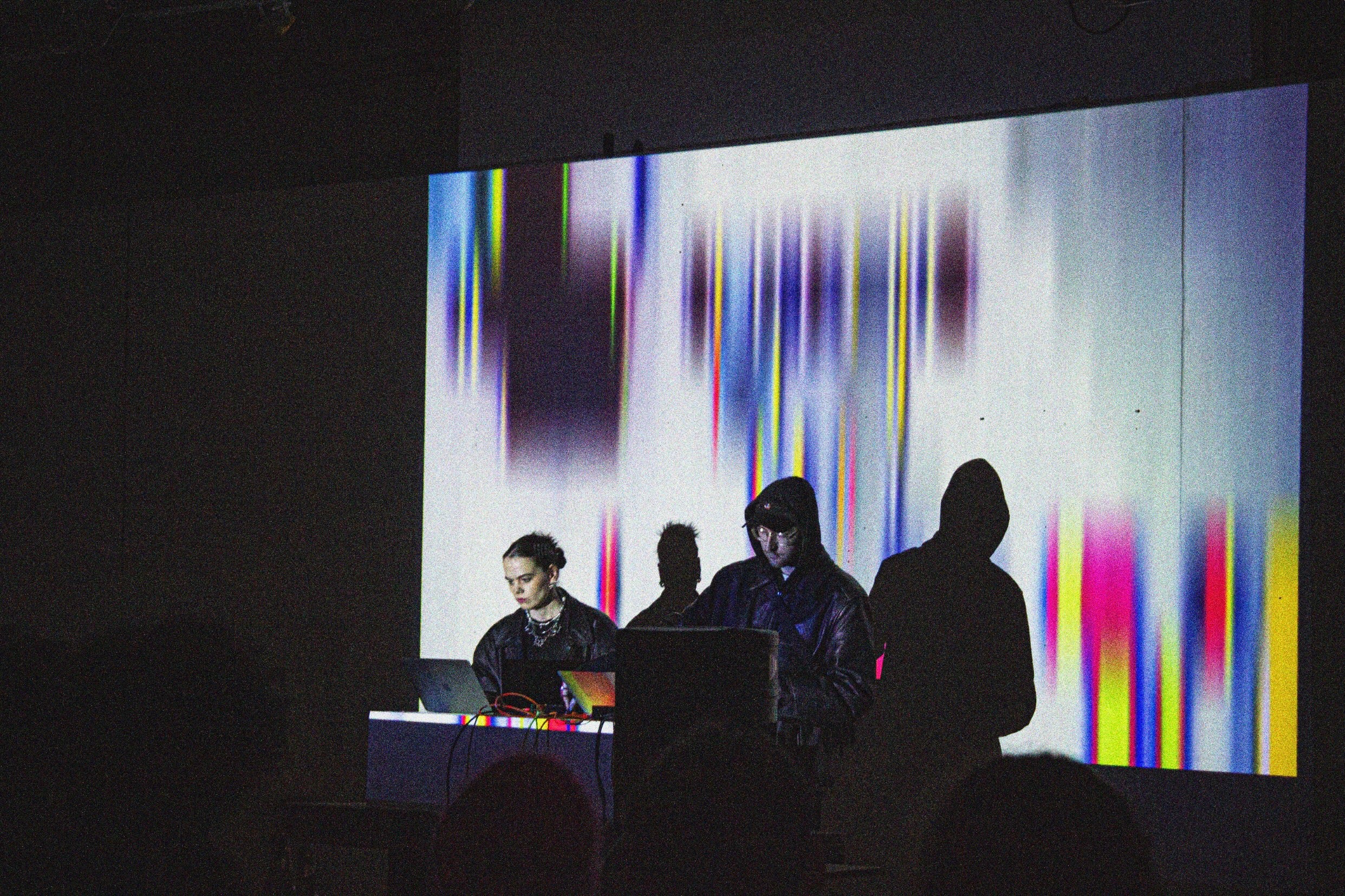
For both Callum and Imogen, the Japanese audio-visual artist Ryoji Ikeda is a huge inspiration. They saw his 2021 exhibition at 180 Studios, including his data-verse trilogy, and saw how far this medium could go in order to create what they describe as a ‘watershed’ experience. ‘Sometimes when you go to a concert, exhibition, film, something like that, it turns you upside down a little bit; something you thought you were really set on is called into question.’
A formative moment for Callum long before even music college was seeing a performance of the piece for quartet ‘Tetras’ by Iannis Xenakis. The work used techniques like glissandi and intentionally warped tuning in way that was seamlessly coordinated between the players. Reading up on the composer, Callum learned the music was written using algorithms to decide the length of the glissandi, the specificity of the intervals, providing an initial insight into the possibilities beyond traditional composition.
Club culture is another inspiration, with Imogen and Callum wanting their performances to create a similarly physical response. As an audience member their work is intense, and at points hypnotic. ‘When you’re in the club you’re hit by significant sound pressure, you’re sort of at the mercy of it in a way that feels like your consciousness is being altered, not just your emotions.’ Emotionally, the audience response is often different to what they expect, without the clear throughline of chord progressions and melody leading to a specific emotional outcome.
The intensity can be uncomfortable, and intentionally so - they’re both interested in creating sounds that challenge and unsettle. Most recently they created a piece entitled ‘dark site’ for the multidisciplinary exhibition PLAYFORM, curated by Resonant Ground, which explored postmodern architecture. Imogen and Callum created their piece around the stimulus of data centres. With their interest in creating hostile sounds, the choice is particularly relevant – there is increasing focus on the invisible but damaging cost of the infrasound the data centres emit. Recently the New York Times published an article on these below-human hearing frequencies that cause symptoms such as insomnia, headaches, internal ear pressure, nausea and anxiety.
The inspiration of data centres also provided rich material for their interest in memory slippage. The new data centres being built are increasingly used for AI training rather than just data storage. ‘We were thinking about how knowledge could be transformed within these data centres in a speculative future of cosmic time scales of thousands of years. What would be within these data centres? How would the memories of human knowledge be transformed? What would an AI store about humans if we weren’t here?’ Ultimately, the piece shows how little control we have over this speculative future.
The audiovisuals of ‘dark site’ have infinite variety; Imogen and Callum established the logic, and the outcomes chosen each time by the computer are different. CCTV images flicker to lines of code, dissolve to Amazon reviews; dots and pinpricks of sound repeat. The piece portrays how in this imagined future information and memory will be changed beyond recognition; the audiovisuals representing the final epochs imagined within the piece are completely distorted.
The name itself is a reference to the increased hostility of these buildings, as fewer humans will be involved in construction, maintenance and security – vast, blackout spaces with permanently lowered levels of oxygen in the air.
A bleak view of the future. And yet, for Imogen and Callum, technology is a rich source of, and enhancer of, creativity, not purely a dark abyss swallowing up human endeavour. ‘One of the most generative aspects of our work is the computer making choices, as there is such a massive number of unpredictable possible states. You can’t do that manually! Technology helps us curate an experience that is as immersive and innovative as possible. That’s what we’re focused on, rather than being occupied with the fact our work isn’t purely live human performance.’
In fact, Imogen has found that their audio-visual creations have influenced her approach to playing classical music. ‘I used to hate playing music by composers like Bach – I’d be like, why are there all these unspoken rules, why do I have to play this exactly as it is on the page? Now I enjoy playing it without feeling so constrained by the rules.’
Callum agrees: ‘what interests me is the relationship between the composer and the musician, rather than trying to make the performer perfectly execute my rhythms. It’s kind of even more the case with the computer, because it’s executing my rhythms perfectly anyway.’
Their work shows both the possibilities technology creates within music whilst acknowledging the unknown and therefore threatening potential that comes with it. ‘Our aim with our work is to present technology in a new way – to show what a fluid, complex topic it is and to encourage people to question their own relationships with it.’ A relationship that will become harder to navigate, as ribbons of code write a reality that is spiralling forwards in ways no-one can predict.
Links to their work:
snake_case website: https://www.snakecasehq.com/
snake_case insta: https://www.instagram.com/_snake_case_/
Imogen’s website: https://www.imogendavey.com/
Callum’s website: https://www.callummurray.com/